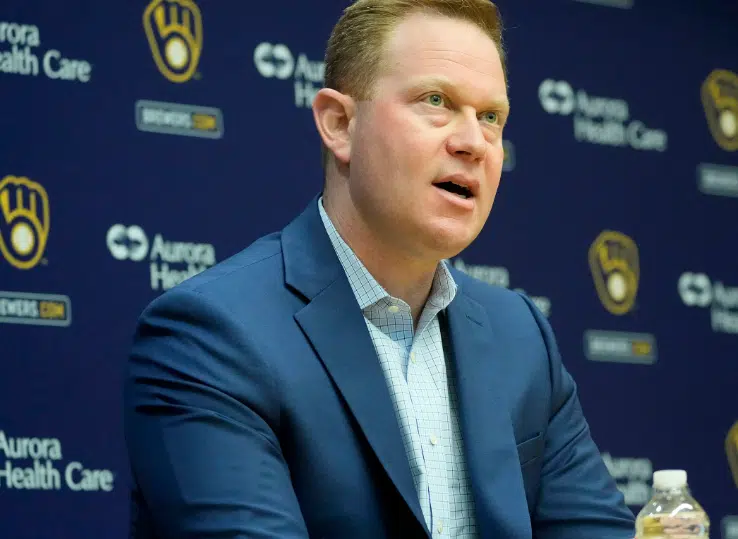
Matt Arnold held his season ending press conference yesterday. It was littered with platitudes for players that had good years, vague statements about the future, how they might approach 2024, etc. Like a certain radio morning show I’m familiar with, he talked a lot without saying much.
In the Brewer post-mortem podcast we did last week, I mentioned that I feel like this fan base is at a crossroads. I used one of the more terrifying elements of my catholic school upbringing as an analogy for where we’re at as a franchise right now: Purgatory. We were in hell for a LONG time. 95-100 loss campaigns, seasons that were essentially over before they started, years where Glendon Rusch was making regular starts. In fact if I had to use one player-picture to describe that 20 year run, it may well be Glendon Rusch circa 2002:

No offense intended to Glendon, who by all accounts seems like a good guy.
It was a difficult stretch to be a Brewer fan. Then the 2008 season hit, and they were finally able to break through and claim a playoff spot. There were more ups (2011) and downs (2012-2015) from there, but from the 2017 season on, this franchise turned a corner. Every year they’re winning 85+ games, every season they’re either in the playoffs or in the conversation until the final weeks. That would have seemed unfathomable in the mid-90’s, but here we are.
The point is: They’re out of hell! And we appreciate that! Hell was decidedly unfun. The problem is: We still haven’t made it to heaven. They came close in 2018, but Milwaukee still hasn’t seen a World Series since 1982, and we haven’t seen a title….well ever.
Hence: Crossroads. The franchise has figured out a way to be a consistent winner by focusing on pitching and defense. Again: Great! But we’ve seen the last 5-6 seasons all dissolve quickly in the playoffs (or just short of them, as in 2022). Watching a team play winning baseball for 6 months, getting our hopes up, only to get slapped across the face with reality less than 30 hours into a playoff run is starting to wear thin. It makes me think of this scene with Bill the Butcher from Gangs of New York:
The fan base feels like Bill (I call him Bill) in this scene. The 88-90 win years that end abruptly in the playoffs are starting to feel lukewarm, so the fan base is isn’t reveling in them like we did in 2008. We are spitting them out, tired of them.
Which leads me to the point of this blog (I knew we’d get to one!): Should this team attempt to go ‘all in’ for 2024, future be damned? The biggest question marks the team has as we enter the offseason revolve around Corbin Burnes, Willy Adames, and Brandon Woodruff. Woodruff’s injury complicates his situation a bit more, but for the sake of argument, let’s just say he has Reggie White healing powers and will be fine by Opening Day 2024.
Conventional wisdom for a small market team screams: TRADE THEM! Their team control is up after next year, you don’t have the payroll to bring any of them back on long-term deals, so get a bunch of prospects to add to the farm system, and continue to build from within with pitching and defense. Stay a consistent winner, even if that means falling WELL short in the playoffs.
But what if we did something different? What if we did what we did in the offseason between 2010 and 2011? In that offseason, Prince Fielder was entering his final year of team control, just like Burnes/Adames/Woodruff are this season. There was no chance he was signing long term (especially with Scott Boras as his agent, just like Corbin Burnes this year), so get what you can for him and try to do a soft reset. That was the most logical move.
Doug Melvin, however, pivoted. He saw a team that had a loaded offense with Fielder, Braun, Weeks, Hart and JJ Hardy, and a ‘blah’ pitching staff. He could trade Fielder for pitching, sure. But what does that gain him? In all likelihood, it’s net zero. So, he pulled a Costanza and did the opposite. He traded his own prospects for pitching. He acquired Zack Greinke and Shaun Marcum to add to Yovani Gallardo and Randy Wolf. He said, ‘we’re going for it.’ We’re probably going to lose Prince and get nothing for him at the end of the year, but if that year ends with hanging a championship banner, who’s going to care?
Of course we all know that it didn’t quite work out. They were frontrunners most of the season, won 96 games (then a franchise record), and ultimately were eliminated by the team-that-shall-not-be-named in 6 games of the NLCS. Two games short of a World Series run. Ultimately they needed to trade Greinke at the deadline in 2012, and the 2013 season was a mess. But that was a price Melvin was willing to pay to make a legitimate run at it.
So why not attempt that in 2024? It’s the reverse issue now, the Brewers actually have homegrown pitching and lack any pop offensively, but why not dial up that playcall again 13 years later? Trade some of your prospects (not named Jackson Chourio) to get a few impact, middle-of-the-order bats. Maybe throw ACTUAL money at a big name, not aging veterans or utility players like we have been. Get the bat-version of getting Marcum and Greinke before 2011. Pair this pitching staff up with a real lineup for a full season, make a real run at a title, and whatever happens after 2024, happens.
At the end of the day, the choose-your-own-adventure question is this:
Would you rather this team continue to win 85-90 games and get quickly dusted out of the playoffs?
Or would you rather they go all-in for a season, attempt a real championship run, and then probably suffer through some 85-90 loss seasons, regardless of whether or not they actually win a title.
I think I’m on board for plan #2.
PS: The crop of big bats in the free agent class is pretty thin. But just like we said in the pre-trade deadline blog: This team has a loaded farm system. They have the prospects to get just about any bat they want via trade.